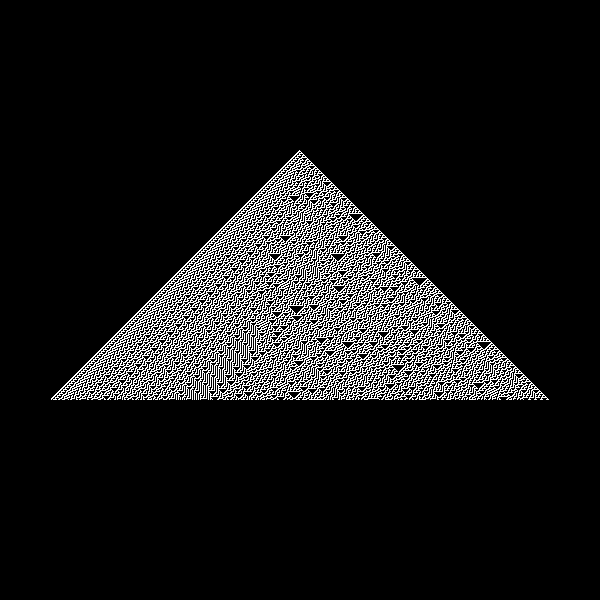
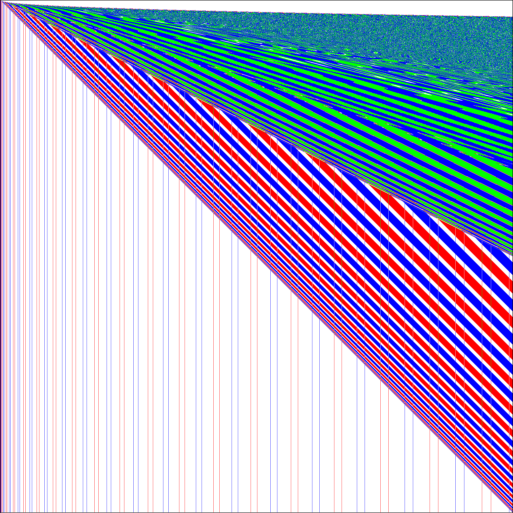
One thing that makes cellular automata especially fun is that you can make your own computational experiments with them.
if you are interested in any of these questions or in collaborating with me to try to answer them pease don't hesitate to contact me!!
Experiment #1: Rule 30's central column
Since some time ago I have been conducting some experiments regarding the middle column of Rule 30. Is the sequence defined by its values periodic? Are there the same number of 1's and 0's? Some of these questions are addressed more deeply here, where Stephen Wolfram has offered 30,000 USD for any answers.I have finally calculated 1,000,000 values of the central column of Rule 30

65558 = 10000000000010110 65701 = 10000000010100101 65723 = 10000000010111011 65840 = 10000000100110000 65893 = 10000000101100101 65939 = 10000000110010011 65943 = 10000000110010111 65954 = 10000000110100010 65959 = 10000000110100111 65961 = 10000000110101001 65981 = 10000000110111101 66015 = 10000000111011111 66128 = 10000001001010000 66157 = 10000001001101101 66165 = 10000001001110101 66187 = 10000001010001011 66191 = 10000001010001111 66224 = 10000001010110000 66342 = 10000001100100110 66361 = 10000001100111001 66364 = 10000001100111100 66536 = 10000001111101000 66549 = 10000001111110101 66572 = 10000010000001100 66594 = 10000010000100010 66615 = 10000010000110111 66629 = 10000010001000101 66753 = 10000010011000001 66761 = 10000010011001001 66809 = 10000010011111001 66874 = 10000010100111010 66876 = 10000010100111100 66964 = 10000010110010100 67095 = 10000011000010111 67127 = 10000011000110111 67134 = 10000011000111110 67261 = 10000011010111101 67265 = 10000011011000001 67277 = 10000011011001101 67341 = 10000011100001101 67375 = 10000011100101111 67452 = 10000011101111100 67482 = 10000011110011010 67518 = 10000011110111110 67572 = 10000011111110100 67651 = 10000100001000011 67719 = 10000100010000111 67736 = 10000100010011000 67739 = 10000100010011011 67749 = 10000100010100101 67783 = 10000100011000111 67834 = 10000100011111010 67871 = 10000100100011111 67875 = 10000100100100011 67896 = 10000100100111000 67897 = 10000100100111001 67924 = 10000100101010100 67928 = 10000100101011000 67972 = 10000100110000100 67987 = 10000100110010011 68077 = 10000100111101101 68126 = 10000101000011110 68135 = 10000101000100111 68144 = 10000101000110000 68158 = 10000101000111110 68218 = 10000101001111010 68220 = 10000101001111100 68226 = 10000101010000010 68258 = 10000101010100010 68420 = 10000101101000100 68511 = 10000101110011111 68604 = 10000101111111100 68612 = 10000110000000100 68675 = 10000110001000011 68773 = 10000110010100101 68904 = 10000110100101000 68982 = 10000110101110110 69081 = 10000110111011001 69084 = 10000110111011100 69208 = 10000111001011000 69231 = 10000111001101111 69335 = 10000111011010111 69339 = 10000111011011011 69345 = 10000111011100001
Notice how the first couple of them begin with the string 100000000xxxxxxxx, then the following terms begin with the string 100000001xxxxxxxx, then 10000001xxxxxxxxx, then 10000001xxxxxxxxxx, etc. It seems like teh digit 1 at the end is simply shifting to the left. It seems reasonable, however, that if the string 10000xxxxxxxxxxxx does not seem to appear, then the value of x doesn't really matter and the structure of the data comes simply because I'm searching for the numbers in order. I suspect, however, that with more digits of the middle column of Rule 30 strings of the form 10000xxxxxxxxxxxx will appear and delete many of the current candidates from the list.
It is however interesting to see if some of these numbers survive billions and billions of iterations of Rule 30. Unfortunately I don't have enough computational power to check this, although I'm optimistic that through many small iterations every now and then I will be able to collect a significant amount of data and hopefully conjecture some interesting results.
66549 = 10000001111110101 67341 = 10000011100001101 67518 = 10000011110111110 69823 = 10001000010111111 73465 = 10001111011111001 74809 = 10010010000111001 75165 = 10010010110011101 75476 = 10010011011010100 76869 = 10010110001000101 83545 = 10100011001011001 85973 = 10100111111010101 88394 = 10101100101001010 92087 = 10110011110110111 94647 = 10111000110110111 98209 = 10111111110100001 98806 = 11000000111110110 100002 = 11000011010100010 101805 = 11000110110101101 102049 = 11000111010100001 105136 = 11001101010110000 105971 = 11001110111110011 107178 = 11010001010101010 112247 = 11011011001110111 118890 = 11101000001101010 121147 = 11101100100111011 121543 = 11101101011000111 122117 = 11101110100000101 123451 = 11110001000111011 128995 = 11111011111100011 129170 = 11111100010010010 130237 = 11111110010111101 131129 = 100000000000111001 131137 = 100000000001000001 131166 = 100000000001011110 131199 = 100000000001111111 131300 = 100000000011100100 131533 = 100000000111001101 131545 = 100000000111011001 131562 = 100000000111101010 131569 = 100000000111110001 131725 = 100000001010001101 131732 = 100000001010010100 131787 = 100000001011001011 131820 = 100000001011101100 131838 = 100000001011111110 131919 = 100000001101001111 131923 = 100000001101010011 132022 = 100000001110110110 132044 = 100000001111001100 132070 = 100000001111100110 132077 = 100000001111101101 132140 = 100000010000101100 132157 = 100000010000111101 132176 = 100000010001010000 132225 = 100000010010000001 132257 = 100000010010100001 132303 = 100000010011001111 132321 = 100000010011100001 132324 = 100000010011100100 132329 = 100000010011101001 132342 = 100000010011110110 132398 = 100000010100101110 132417 = 100000010101000001 132454 = 100000010101100110 132491 = 100000010110001011 132508 = 100000010110011100 132551 = 100000010111000111 132573 = 100000010111011101 132617 = 100000011000001001 132723 = 100000011001110011 132801 = 100000011011000001 132869 = 100000011100000101 133098 = 100000011111101010 133099 = 100000011111101011 133112 = 100000011111111000 133135 = 100000100000001111 133145 = 100000100000011001 133148 = 100000100000011100 133198 = 100000100001001110 133210 = 100000100001011010 133257 = 100000100010001001 133266 = 100000100010010010 133272 = 100000100010011000 133432 = 100000100100111000 133456 = 100000100101010000 133490 = 100000100101110010 133505 = 100000100110000001 133507 = 100000100110000011 133637 = 100000101000000101 133645 = 100000101000001101 133718 = 100000101001010110 133788 = 100000101010011100 133816 = 100000101010111000 133821 = 100000101010111101 133830 = 100000101011000110 133925 = 100000101100100101 133928 = 100000101100101000 133936 = 100000101100110000 133978 = 100000101101011010 134121 = 100000101111101001
Notice how the vast majority of terms that did not appear in the first 500,000 values of Rule 30's central column appear in the first 1 million values . Will this happen with any string?Back to page index
-------------------------------------------------------------------------------------------------------------
Experiment #2: An algorithm for calculating square roots
Some time ago I described an algorithm for cumputing sqrt(2) using Pascal's Triangle. Strictly speaking this is not a cellular automata (although one can partially obtain it by computing Rule 60 mod k for a large enough k). Nevertheless I've decided to include it here because I find it very interesting and worth exposing. Rule 60 is one of the so called "aditive" cellular automata which have very nice properties (like linearity and being easily described by generating functions).
Anyways, the algorithms reads as follows:
- 1. Compute the n-th row of Pascal's Triangle (the larger the n, the better).
- 2. Ennumerate the elements of this row, starting from 0.
- 3. For all elements x in even positions 2k, consider the sum of x*2^(k) for all x in the given row. Denote this sum by X.
- 4. For all elements y in odd positions 2k+1, consider the sum of y*2^(k) for all y in the given row. Denote this sum by Y.
- 5. Then sqrt(2) is approximately X/Y.
A small example always helps clarifying things. Let n = 5:
- 1. The 5-th row of Pascal's Triangle reads 1,5,10,10,5,1 .
- 3. X = 1*2^0 + 10*2^1 + 5*2^2 = 41
- 4. Y = 5*2^0 + 10*2^1 + 1*2^3 = 33
- 5. X/Y = 41/33 = 1.242424... which is APPROXIMATELY sqrt(2)
For n=10 we get X/Y = 1.4142131979695431 which is not too bad.
One can give an elementary proof of this algorithm by considering the continous fraction of sqrt(2) (TRY IT!)
Another interesting thing is that this algorithm is generalizable to sqrt(n) (and here is where cellular automata come into play): Instead of Pascal's Triangle, we are going to run Rule 60 mod k (for large k) starting with the initial condition of a single cell with the value n. We then repeat the described algorithm in this new setting and we get an approximation of sqrt(n).
For n=3 and using the 10-th row of Rule 60 we get X/Y = 1.7320261437908496..., and sqrt(3) = 1.732050807...
Back to page index
-------------------------------------------------------------------------------------------------------------
Experiment #3: Storing large values of Rule 30's rows
The recursive nature of cellular automata make them computationally costly to calculate. However, if one has stored the values of a given row, then one can calculate all of the following rows of the automata (with this program). That's why I've calculated several rows( rows number 100,000; 200,000; 300,0000; 400,000; 500,000; 524,999; 555,000; 675,000; 700,000; 800,000; 820,000; 840,0000 and finally 1,000,000) in index format, which means that I'm storing the indices of the cells of value 1. If we start with a single cell with the value 1, and we assign that cell the index 0, then the cell directly to the left will have the index -1 and the cell directly to its right will have the value 1. In this way, the array [-1,0,1] codifies the row with values 111, where the middle 1 lays just below our lonely initial condition valued 1 in index 0. This makes it computationally advantageous to work with since, given an indexed array, knowing the value of the central column at that generation reduces to simply asking: is 0 in the array? If so, then the central column has value 1 (since the array stores the indices of the cells which have value 1), otherwise the central column has value 0.
For clarity I'll give an example. Consider Rule 30 with the initial condition of a single cell with the value 1:
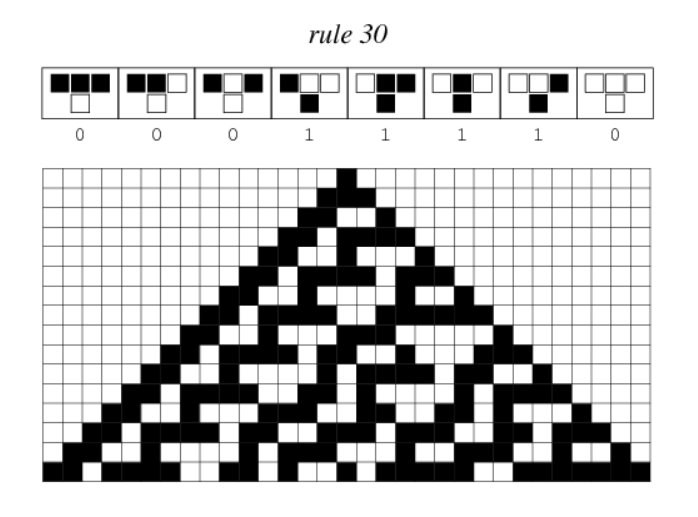
Here, a cell with value 1 is depicted black, and a cell with value 0 is depicted white. The row index arrays would read:
- row0 = [0]
- row1 = [-1,0,-1]
- row2 = [-2,-1,2]
- row3 = [-3,-2,0,1,2,3]
Back to page index
-------------------------------------------------------------------------------------------------------------
Experiment #4: A random number generator based on Rule 30's central column.
(You can find the algorithm described below here.)
Given the following image
- Choose a random point (x,y) from the image above.
- Choose a random direction (right, diagonal right up, up, diagonal left up, left, diagonal left down, down, diagonal right down)
- Read k bits starting from (x,y) and in the chosen direction.
A few consideration for the implementation of the algorithm:
- The image is 1,000 x 1,000 pixels, so the random point (x,y) should be chosen in a way that x and y live in the interval (k,1000-k) in order to be able to read k pixels in any direction.
- The directions can simpy be encoded by numbers from 1 to 8.
- I belive this algorithm to be highly dependant on the choice of (x,y), so for benchmarking I'll just use Julia's random number generator for choosing the initial values of (x,y). In practice I believe a good idea would be to ask the user for two random x,y or get them from the system somehow.
Anyway, here's a plot of my benchmarks:
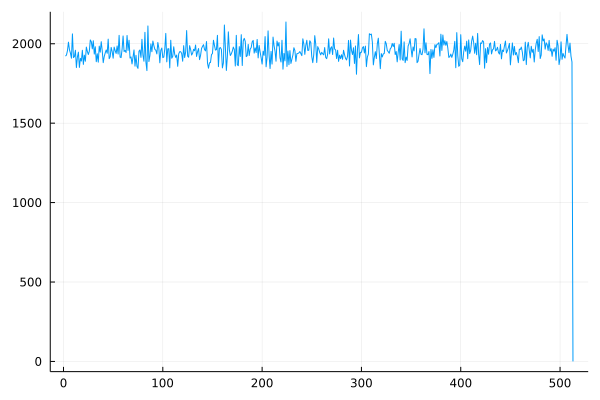
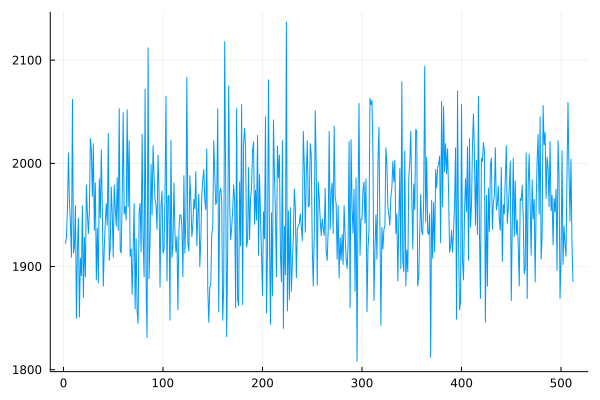
The sudden fall to 0 is explained by the fact that 512 = 2^9 is the first number to have 10 bits and the runs were made by taking only 9 bits.