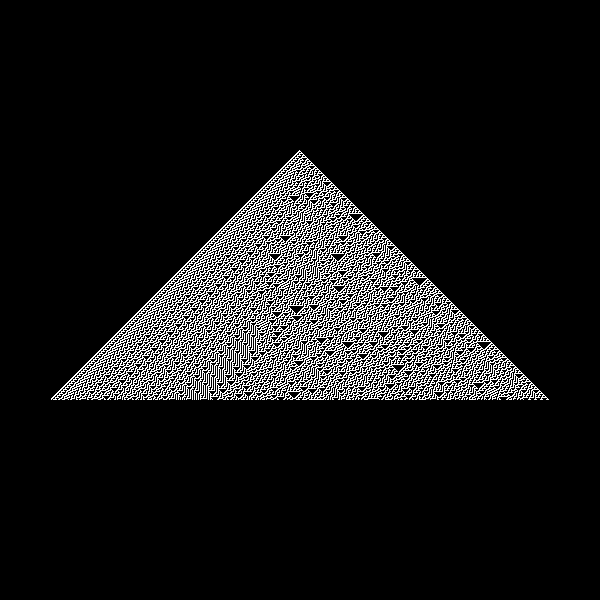
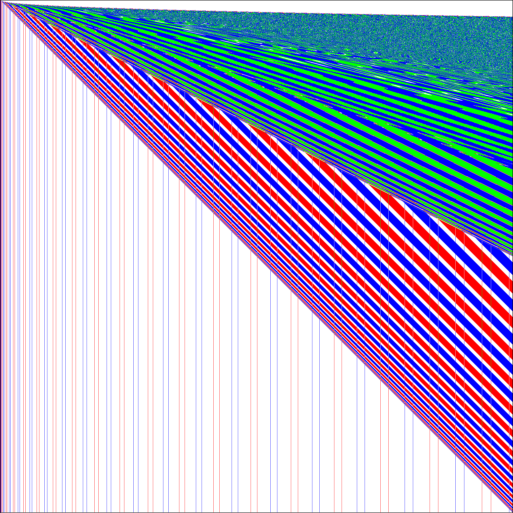
I've been fascinated with cellular automata ever since I read Wolfram's New Kind of Science.
One can think of cellular automata as the simplest (deterministic) models of simple entities interacting with each other, and soon enough they become surprisinlgy unpredictable and hard to describe in mathematical terms.
I like to explain cellular automata in the following way: picture a checkerboard (an infinite checkerboard, actually) with all cells colored white except for the middle cell, which will be colored black. At every second, the cells in this checkerboard are going to change colors according to some fixed rule.
For example, let's say that if a cell has a neighboring black cell, then at the next second it will turn black. Otherwise, it will remain white. What's the state of the blackboard in, say, one hour?

It is not hard to see that with this rule, the whole checkboard quickly becomes black (is this evident for you?),
since the neighboring cells of the initially black cell will turn black, and then their neighbors will turn black, and then the neighbors of their neighbors, and so on. Quite simple, right?
But what happens with a smarter rule? Say, something like: if a black cell has exactly two or three black neighbors, then it will remain black in the next second. If a white cell has exaclty three black neighbors, it will become black in the next iteration. If none of these two scenarios occur, the cell will become white in the next second.
What will be, then, the color of our checkerboard after an hour? In this case, after just one second every cell will be white, since there are too few black cells to start with. But what if we had more black cells in the beginning? Well, turns out that
this set of rules are as powerful as any computer (like the one you are using to read this, right now). You've basically just discovered
Conway's Game of Life (which is
Turing complete and can simulate a
universal constructor or any other Turing machine: that's what I mean by as powerful as any computer).
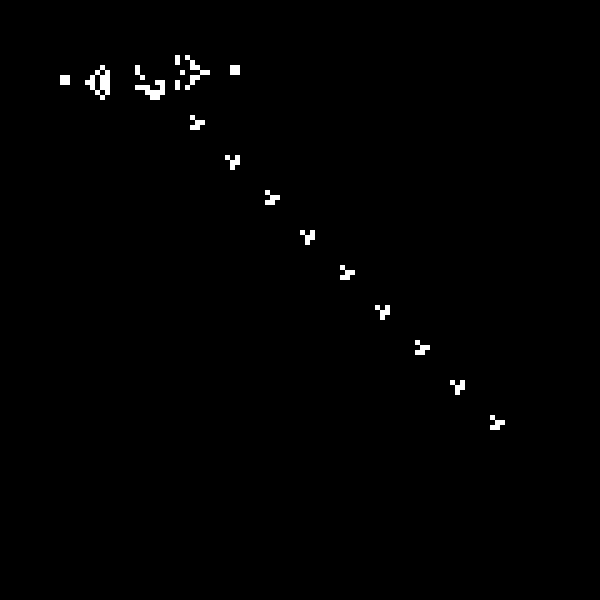 A glider cannon in Conway's Game of Life
Knowing what happens with the checkboard in one hour, or two, or what the state of the checkboard will be as time tends to infinity
is an extremely difficult question to answer, and this is the case with many cellular automata. We simply can't capture them with mathematics (
or can we?).